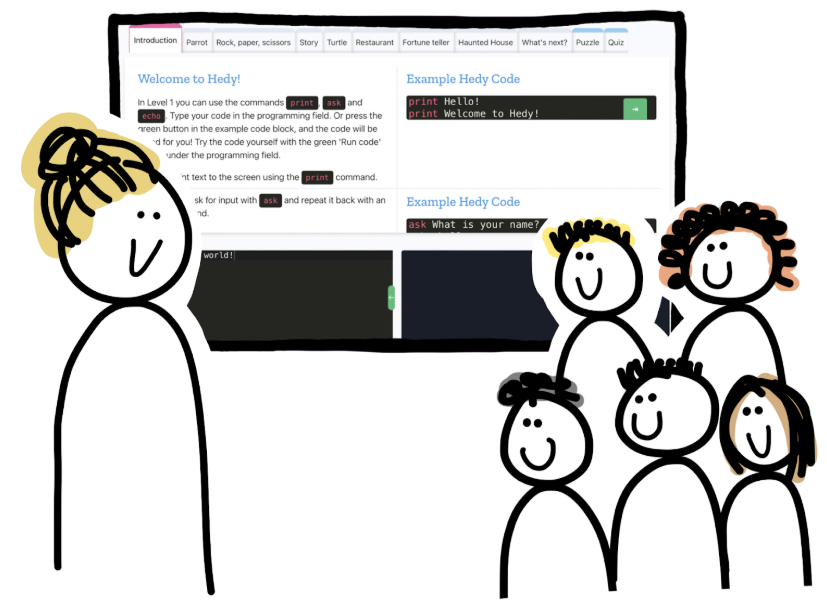
Textual programming made easy with Hedy!
The Network Institute is proud to share news about a project developing the Hedy programming language, to which three student assistants – Sami, Deveny, and Floris – funded by the NI, have been making valuable contributions.
Many schools and teachers around the world want to teach their students programming. Initially this is often done with playful tools, ranging from the Bee-Bot robot to Scratch Junior or Scratch. After using such tools, kids often want to move to more powerful, textual programming languages, like Python.
Python however is hard, because it is only available in English, and requires learners to learn complex programming concepts and syntax at once. Our programming language Hedy is the easy way to get started with textual programming!
Hedy is free to use, open source, and unlike any other textual programming language in three ways:
- Hedy is multi-lingual — you can use Hedy in your own language
- Hedy is gradual — you can learn one concept and its syntax at a time
- Hedy is built for the classroom — allowing teachers to fully customize their student’s experience
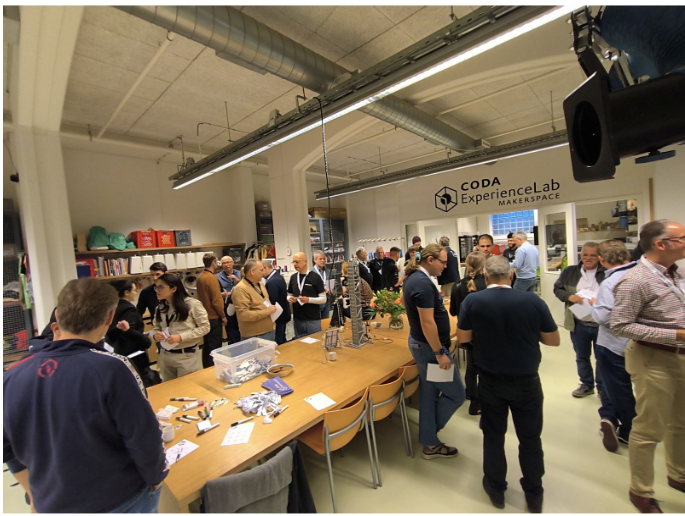
Student-assistants Sami, Deveny and Floris have been a great help to this project the last couple of months. They have been helping out at several events, like CoderDojo Nederland and Urban Scientist Festival, where they have shown kids the joy of programming and helped teachers set up Hedy lessons in their own CoderDojos.
Secondly, they have been reaching out to teachers all over the world who are working with Hedy, but have trouble getting started. Sami, who conveniently speaks 4 languages, has been reaching out to these teachers and either helping them out himself or matching them up with a buddy-teacher.
Thirdly, they have been helping us by translating content. Because of its multi-lingual nature, Hedy is a very popular tool in countries with non-English speaking students. The more content is translated, the more kids in non-English countries will also get access to the world of programming.
And lastly, as everyone working with software will know, there are always bugs appearing here and there. Luckily these computer scientists-to-be are also very handy in fixing these bugs, so that our teachers can get on with their lessons without software trouble.