
How do we move towards a more inclusive and sustainable city where the technology we adopt is under our own collective control? What is needed to make progress on that journey and what is the role of academia, governments, societal organisations and private companies?
These were the guiding questions for an event that Waag Futurelab organised in collaboration with VU Amsterdam in the iconic Waag building in the city centre of Amsterdam. Waag’s Research Director and VU Research Fellow Sander van der Waal hosted the afternoon, where in three panel discussions various dimensions of Digital Autonomy were explored.
The event kicked off with the introduction of six dimensions of this Public Stack framework and corresponding key questions to address when assessing existing technology, or designing new technology.
In three panel discussions, these perspectives were explored further from the frame of Digital Autonomy.
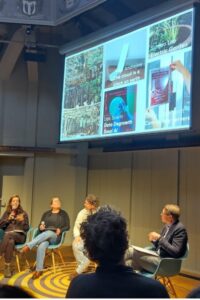
Towards a more equal and inclusive society
Firstly, the focus was on power, representation and ownership. Ilse Heeremans (SINA) and Karien Sondervan (Cybersoek) work daily with Amsterdam residents who struggle to participate in today’s increasingly digital society. In Amsterdam, 20% of citizens struggle with digital systems, with responsibility often falling on underfunded organizations. Pascal Wiggers emphasized “situated technology” – designing systems with affected users’ real-life perspectives. A key conclusion: digital systems should never fully replace personal interactions; human-centered options must remain equally valued.
Towards democratic ownership and governance
In the second panel, we turned the focus towards social media platforms and discussed their ownership and governance aspects. Danny Lämmerhirt introduced community-level governance as a middle ground between platform moderation and individual controls, allowing users collectively to shape online spaces. Next up was Mariken van der Velden, who discussed how algorithm-driven polarization drowns out moderate voices and influences politicians toward emotionally charged statements. The discussion noted that while polarization exists (like football rivalries), we lack the equivalent “playing field” for constructive dialogue.
Towards a healthy and regenerative planet
The last discussion of the day centered on the environmental impact of technology. Judith Veenkamp’s artistic collaborations revealed new ways to consider technology’s environmental footprint. Patricia Lago’s Sustainability Assessment Framework Toolkit helps organizations evaluate software’s environmental impact, stressing that “there is no sustainability without digital autonomy and sovereignty.” Robert Keus of GreenPT emphasized full technology stack control for meaningful environmental transparency in AI deployment.
Concluding reflections: towards a people-centered, sustainable Public Stack
We look back on a stimulating event, that demonstrated the need for a holistic approach to digital autonomy that preserves human interactions – paying attention to non-digital autonomy too – implements community-level governance for social media, and integrates environmental sustainability into system design and deployment.
For more interesting future events, keep an eye on our page and de Waag.